

Ernestina-Morrissey — A Gloucester Schooner Festival Story
From a photograph to an unexpected invitation aboard one of America's historic schooners

Sometimes a photograph becomes more than the image you captured.
Earlier this summer, I photographed the historic schooner Ernestina-Morrissey. One of those photographs was later purchased by a customer who told me that her daughter, Kate Riley, works aboard the vessel as its educational director. That unexpected connection led to an invitation I never anticipated. When Ernestina-Morrissey returned to Gloucester for the 2026 Gloucester Schooner Festival, Kate invited us aboard for a personal tour. I arrived with my camera and an opportunity to see, from a very different perspective, a schooner whose story is deeply connected to Gloucester's maritime history. What I discovered was that Ernestina-Morrissey isn't simply a beautifully restored historic vessel.
She is a living piece of Gloucester history — and her story is still being written.
Born Into Gloucester's Fishing Heritage

The schooner was launched on February 1, 1894, at the James & Tarr shipyard in Essex, Massachusetts. Originally named Effie M. Morrissey, she was built for Captain William E. Morrissey and the John F. Wonson Company of Gloucester and named for Captain Morrissey's daughter. She began her working life as a Gloucester fishing schooner, carrying fishermen to the Grand Banks and the waters off Labrador, Nova Scotia and Newfoundland in search of cod, haddock, halibut and other species. There is another remarkable Gloucester connection. Captain William Morrissey's son, Clayton Morrissey, later commanded the schooner — and served as the model for Gloucester's famous Fishermen's Memorial on Stacy Boulevard.
For someone photographing schooners in Gloucester more than a century later, it is difficult not to appreciate that connection.
From the Grand Banks to the Arctic

In 1926, explorer Captain Robert "Bob" Bartlett acquired Effie M. Morrissey and transformed the former Gloucester fishing schooner into an Arctic exploration vessel. Over the following decades she participated in scientific and exploratory voyages to the far north. In 1940, the vessel reached to within approximately 600 miles of the North Pole. During World War II she also served in Arctic supply and survey work. The schooner that once carried Gloucester fishermen to the Grand Banks had become an Arctic explorer. But even that was not the end of her travels.
Ernestina and Cape Verde

After her years of Arctic exploration, the schooner began yet another remarkable chapter. Renamed Ernestina, she served for years as a Cape Verdean packet vessel, carrying people and cargo between Cape Verde and the United States. Her history became intertwined with generations of Cape Verdean families and the long cultural relationship between Cape Verde and southeastern Massachusetts. In 1982, following an extensive restoration in Cape Verde, the Republic of Cape Verde presented Ernestina to the Commonwealth of Massachusetts as a gift to the people of the United States. Today, Ernestina-Morrissey is the official vessel of the Commonwealth of Massachusetts. Standing aboard her, all of that history suddenly feels much less distant.
Going Aboard Ernestina-Morrissey

Our tour was led by Kate Riley, Assistant Director and Outreach and Education Coordinator for Ernestina-Morrissey at Massachusetts Maritime Academy. This was where the story became personal for me. Kate is the daughter of the woman who had purchased my photograph of Ernestina-Morrissey. That simple connection, beginning with a photograph, had now brought us aboard the schooner. Kate took us through the vessel, above and below deck, sharing details about the ship, her history and her role today.

Walking the deck, looking up through the rigging and then going below, I found myself thinking about all the people who had occupied these same spaces during the vessel's extraordinary life — Gloucester fishermen, Arctic explorers, scientists, sailors, immigrants, students and crew. A camera can record what something looks like.
Sometimes being there lets you understand what it means.
A Historic Ship With a Modern Mission

One of the things I found most interesting is that Ernestina-Morrissey is not being preserved simply as a museum piece. Massachusetts Maritime Academy operates the schooner as a sail-training and educational vessel. Massachusetts law specifically directs the Academy to operate, preserve and maintain her for educational and training purposes and to incorporate the vessel into its sail-training curriculum.
Her programs include seamanship, leadership, marine science, oceanography, shipboard safety, environmental stewardship and STEAM education. Students learn through hands-on experiences aboard a working sailing vessel. Her own history — fishing, Arctic exploration, scientific research and her years as a Cape Verdean packet ship — is also incorporated into that education. That mission is already reaching young people throughout Massachusetts. Massachusetts Maritime Academy reported that a partnership with the Buzzards Bay Coalition brought 650 New Bedford elementary and high school students aboard during 2025 for educational experiences involving science, navigation, maritime history and Cape Verdean culture.
There seems to be something particularly appropriate about that.
A vessel that has spent more than 130 years carrying fishermen, explorers, immigrants and sailors across the sea is now carrying knowledge from one generation to another.
And Then Came the Esperanto Cup

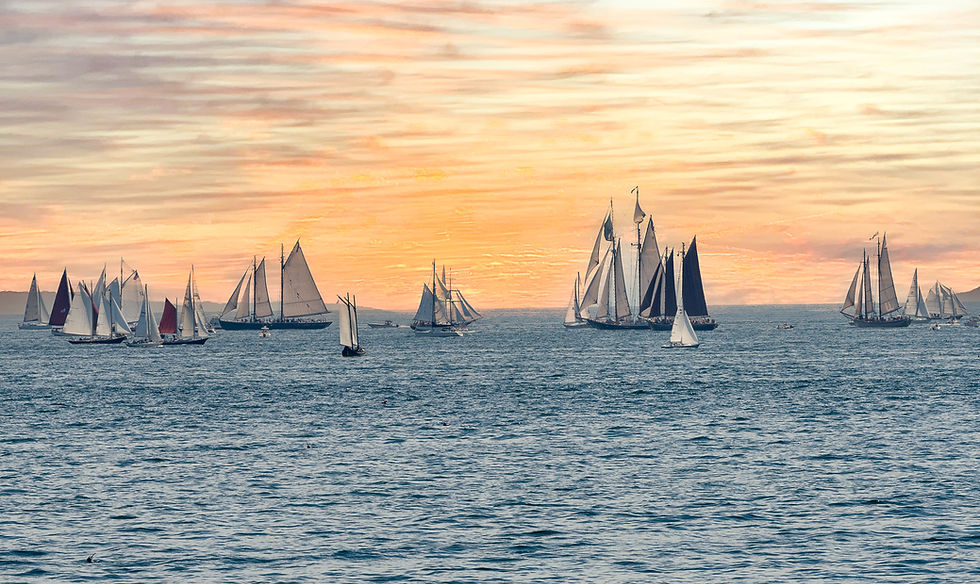
And it was a good one. On Sunday, September 6, the schooners left Gloucester Harbor in the annual Parade of Sail before gathering off Eastern Point for the Mayor's Race. The large traditional schooners were competing for one of Gloucester's most treasured pieces of maritime history:
The Esperanto Cup.
The Cup traces its heritage to the great international fishermen's schooner races of the early 20th century. It was brought home to Gloucester in 1920 by Captain Marty Welch and the crew of the Gloucester fishing schooner Esperanto. Today's Gloucester Schooner Festival continues that tradition, with the large traditional schooners racing for the historic trophy. More than a century later, a schooner that herself began life in the Gloucester fishing fleet went racing for it.
Ernestina-Morrissey won.
The 2026 results placed Ernestina-Morrissey first in the large schooner division, ahead of Adventure and Tabor Boy, earning her the Esperanto Cup.
And remarkably, it wasn't her first. The schooner's own association records another Esperanto Cup victory by Ernestina at Gloucester in 2001. For a vessel launched in Essex in 1894 for Gloucester's fishing fleet, there could hardly have been a more fitting conclusion to her return to Cape Ann.
More Than a Photograph

When I first photographed Ernestina-Morrissey, I was concentrating on the things photographers usually think about — light, composition, sails, sea and sky. I didn't know where that photograph would lead.
A customer purchased the image because the schooner had a personal connection to her family. Her daughter Kate worked aboard the vessel. That led to an invitation aboard during the Gloucester Schooner Festival, a personal tour, and the opportunity to learn much more about the remarkable schooner that had been in front of my camera.
Then, just days later, Ernestina-Morrissey sailed out past Eastern Point and added another chapter to her history by winning the Esperanto Cup.
132 years after beginning her life as a Gloucester fishing schooner, her remarkable journey goes on.
Still sailing.
Still teaching.
Still making history.
And I'm very glad my camera happened to find her.
— Glenn P. Hale
G.P. Hale Imagery


Comments